
PI Renewal and TPB Requirements: What Tax Agents Must Confirm Before Renewing
If you are a registered tax agent or BAS agent, professional indemnity insurance is not just good practice — it is a condition of your registration. The Tax Practitioners Board (TPB) requires every registered practitioner to maintain PI insurance that meets its published requirements, and to confirm that cover as part of your annual declaration.
Most practitioners renew their policy each year without much thought. The premium arrives, it looks about right, and it gets paid. That is understandable — renewal usually lands at a busy time of year. But renewal is also the one natural moment to check that your cover still meets the TPB's requirements and, just as importantly, still matches the practice you are actually running today.
Here is a practical pre-renewal checklist. It takes about 20 minutes with your current policy schedule in front of you.
1. Check your cover level against your turnover tier
The TPB sets minimum amounts of cover based on your annual turnover from tax agent or BAS services (excluding GST). As at July 2026, the tiers are:
Two things to note here.
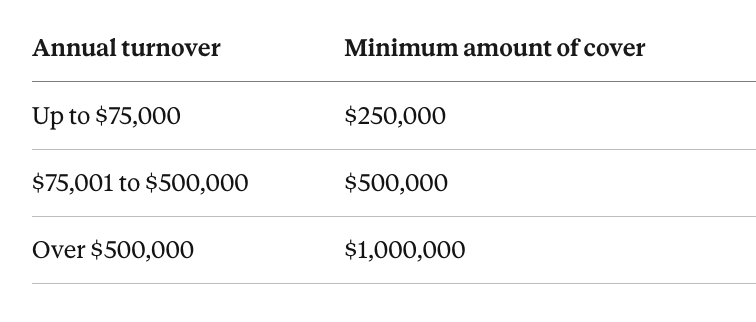
First, the tier is based on your current turnover — not the turnover you had when you first arranged the policy. If your practice has grown past a threshold since your last renewal, your minimum requirement may have changed with it. This is one of the most common ways practices drift out of step with the requirements without realising.
Second, these are minimums, not recommendations for what is adequate. The TPB itself notes that practitioners should consider whether the minimum is sufficient for their circumstances. A firm with large clients, complex advisory work or a high volume of lodgements may sensibly carry more than the tier requires. Note also that tax agents registered with a condition to provide certain financial advice services have a separate, higher minimum — generally $2 million — so if that applies to you, check the specific requirement.
2. Understand how your policy treats legal and defence costs
The TPB's minimum amounts are expressed as inclusive of legal and defence costs. In practice, defending a claim can consume a significant share of a policy limit before any settlement is paid. When you review your renewal terms, ask your broker how your policy treats defence costs — whether they sit inside the limit or are paid in addition to it. If your cover sits at the bare minimum for your tier and defence costs erode the limit, the amount left for the claim itself may be less than you assume.
3. Check your excess
The TPB also sets a ceiling on the excess. For most practitioners, the excess should not exceed 4 per cent of turnover — and where 4 per cent of turnover is less than $1,000, the excess should not exceed $1,000. A policy with a high excess might carry a lower premium, but if the excess breaches the TPB's limit, the policy may not satisfy your registration requirements. This is worth confirming in writing at renewal rather than assuming.
4. Confirm your retroactive cover
PI insurance works on a claims-made basis: it responds to claims made during the policy period, even if the work was done years earlier. That makes retroactive cover essential. If you held a PI policy previously, the TPB requires your new or renewed policy to provide retroactive cover back to the earlier of when you began carrying on your business activities on a continuous basis, or the retroactive date of your previous policy.
The practical risk here is switching insurers at renewal to save on premium and inadvertently accepting a later retroactive date. That can leave past work — sometimes many years of it — without cover. If you are considering a change of insurer, make the retroactive date the first thing you compare, not the last.
5. Plan for run-off cover if your circumstances are changing
If you are winding down, selling the practice or retiring, the claims-made structure of PI insurance means claims can still arrive after you stop practising. The TPB recommends obtaining run-off cover if you propose to cease providing tax agent services. The TPB does not prescribe a duration, but because claims can surface years after the work was done, many brokers suggest maintaining run-off cover for several years after ceasing practice — commonly aligned with relevant limitation periods. If a transition is on your horizon, raise it at this renewal rather than the next one.
6. Keep your notification obligations in view
Your PI cover is not just something you hold — it is something you confirm to the TPB. Newly registered practitioners must advise the TPB of their PI insurance details within 14 days of being notified that registration has been granted. Beyond that, practitioners confirm on an annual basis that they have maintained PI insurance meeting the TPB's requirements. If your policy details change — insurer, cover level, policy period — make sure the details the TPB holds for you stay current.
Letting cover lapse, even briefly between renewal dates, can put your registration at risk. Diarise the renewal date and start the review two to four weeks out, so a question about terms never turns into a gap in cover.
A note on cyber
The TPB has flagged that standard PI policies may not respond to cyber incidents, and encourages practitioners to consider whether separate cyber cover is appropriate. Given how much client financial data accounting practices hold, it is a sensible question to ask at the same time as your PI renewal — even if the answer is simply confirming what your current policy does and does not cover.
The renewal conversation worth having
None of this needs to be complicated. Most of the checklist above is a 20-minute conversation with a broker who knows the TPB's requirements well. If you would like a starting point before that conversation, the Risk Checkr Pro tool gives you a practice risk profile in about two minutes.
And if you would rather talk it through, the team at Abacus is happy to walk you through what your cover actually includes and how it lines up with the TPB's requirements — no pressure, no commitment.